
 Select Language
 English
Polyethylene Foam Recycling Is Going Global: How GREENMAX Foam Recycling Machines Help Turn PE Foam Waste into Value
Polyethylene foam recycling is moving from a “nice-to-have” sustainability project to a practical operational standard across the world. As EPE and other polyethylene foams continue to protect products in transit, insulate temperature-sensitive shipments, and cushion delicate components, businesses are realizing that the same properties that make polyethylene foam useful—light weight and high volume—also make disposal expensive. Polyethylene foam recycling is therefore being adopted not only by recyclers, but by manufacturers, distributors, logistics hubs, and packaging users who want to reduce waste-handling costs while meeting rising customer and regulatory expectations.
What makes polyethylene foam recycling feel like a global trend is how many industries now depend on PE foam. Packaging remains the most visible driver, but PE foam is also common in construction, electronics, and automotive supply chains because it is resilient, clean-looking, and easy to convert into protective shapes. Industry-facing guidance and sector content around PE foam consistently highlights this multi-industry footprint and the growing need for more circular handling of foam waste. As more regions strengthen requirements around packaging waste management and extended producer responsibility, the economic case aligns with the environmental case: if you can make low-density foam easier to store and transport, you unlock real polyethylene foam recycling outcomes instead of paying repeatedly to move “air.”
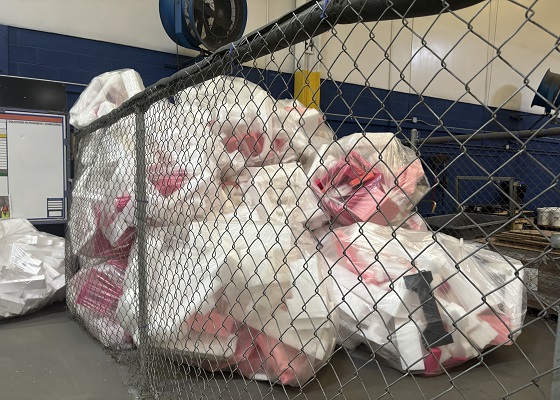
A key barrier has always been logistics. Loose polyethylene foam takes up space fast, and many sites can’t justify frequent collections of low-weight material. That’s why volume-reduction equipment is often the enabling step in polyethylene foam recycling programs. GREENMAX positions its foam recycling machines specifically around this bottleneck, offering solutions that compress polyethylene foam into dense blocks that are easier to handle and ship. Once foam is densified, it becomes a more consistent commodity for downstream processors, and internal housekeeping improves because foam stops spreading across warehouses and production floors.
One practical polyethylene foam recycling case comes from Oregon, where a nonprofit Producer Responsibility Organization needed a scalable foam recycling system that could work across multiple collection realities. In this project, GREENMAX delivered a customized M-C300 foam densifier designed to handle both EPS and EPE, with a workflow-oriented configuration that supported continuous processing and improved labor efficiency. Although the inbound stream was mixed, the relevance to polyethylene foam recycling is clear: when EPE arrives from many generators in fluctuating volumes, a densifier that can reliably process EPE and create a transport-friendly output helps build a system that can expand rather than stall. This is the kind of infrastructure-led approach that is increasingly common worldwide—polyethylene foam recycling isn’t only about the last step of reprocessing; it’s about designing an entire chain that makes collection and consolidation economically stable.
.png)
A second polyethylene foam recycling case centers on a company that upgraded its on-site handling with a GREENMAX PE foam densifier M-C100 as demand for PE foam recycling increased. According to the case description, the densifier was chosen because it could handle EPE sheet as well as PE film, helping keep the warehouse cleaner and safer while also generating value through selling recycled PE ingots. This pattern shows up repeatedly in real operations: when polyethylene foam recycling is treated as a consistent material stream—collected cleanly, densified on-site, and shipped in predictable batches—companies can reduce disposal dependency and turn foam waste into a managed output. The details will vary by site, but the mechanism is consistent: densification converts a bulky nuisance into something that can move through standard logistics.
These cases also reflect why polyethylene foam recycling is accelerating across regions. First, many companies have set public sustainability goals, and foam is an easy target because it is highly visible, voluminous, and often generated in clean industrial settings. Second, recycling markets are adapting; large packaging and materials firms are experimenting with recycled-content and advanced recycling pathways for PE-based materials, which reinforces the demand signal for better feedstock collection and preparation. Third, businesses increasingly want operational solutions that don’t depend on perfect conditions. A well-designed polyethylene foam recycling setup acknowledges reality: foam may arrive in different shapes, in variable volumes, and with occasional contamination, so the front-end process must be robust enough to keep the program running day after day.
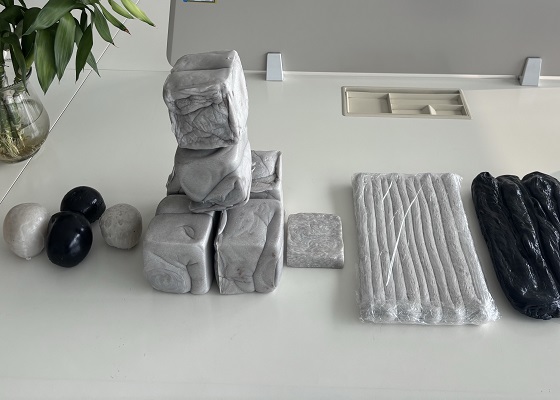
GREENMAX’s broader positioning in the UK and other markets also points to the same conclusion: polyethylene foam recycling is no longer limited to specialist recyclers. It is being adopted by manufacturers, distributors, and packaging companies that want practical, on-site steps—compacting, melting, shredding, or densifying—to reduce volume and stabilize recycling routes. In other words, the world is shifting from asking whether polyethylene foam recycling is possible to asking how to implement polyethylene foam recycling in a way that fits real facilities and real labor constraints.
For organizations evaluating their next move, the most important mindset shift is to treat polyethylene foam recycling as a systems problem. When collection points are mapped, foam is kept as a dedicated stream, and volume reduction is done close to where waste is generated, the rest of the chain becomes simpler. Transport becomes less frequent, storage becomes predictable, and downstream processors are more willing to accept and price the material because it arrives in a consistent form. That is why polyethylene foam recycling is expanding globally: it solves a cost problem and a sustainability problem at the same time, and modern foam recycling machines make it operationally achievable.